From Mapping to Practice – Validating Peacebuilding through the International Donaufest 2026

From Mapping to Practice – Validating Peacebuilding through the International Donaufest 2026
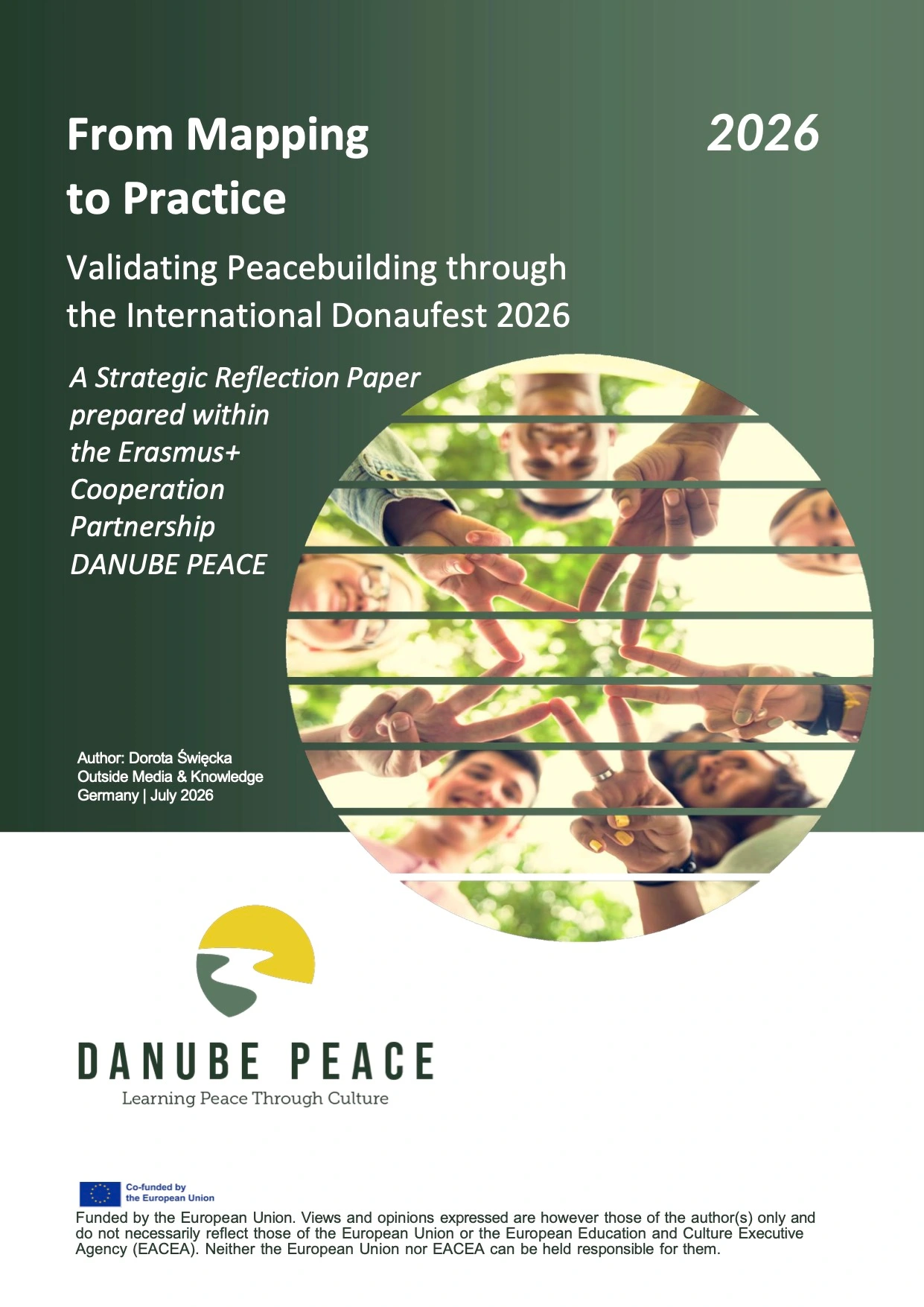
The International Donaufest 2026 in Ulm and Neu-Ulm provided Outside Media & Knowledge – the German partner of the DANUBE PEACE project – with an opportunity to test the principal findings of Work Package 2 against an established example of cross-border cultural cooperation. The exercise was designed as field validation rather than event reporting: evidence gathered through desk research and an expert interview with Sebastian Rihm, Director of Donaubüro Ulm/Neu-Ulm, was compared with direct observation of the Festival’s opening, institutional partnerships, youth activities, public programme and use of shared cultural space.


The opening ceremony provided the clearest evidence that the Festival’s peacebuilding function was explicit rather than incidental. The Lord Mayors of Ulm and Neu-Ulm, Martin Ansbacher and Katrin Albsteiger, began with a minute of silence for people unable to live in peace and affirmed solidarity with “a free and self-determined Ukraine”. This political commitment was given an immediate human presence through a live connection with Alex in Kharkiv, who addressed the audience and performed John Lennon’s Imagine. The intervention connected the public gathered on the Danube with a person participating from a city living under the direct conditions of war. Ukraine was therefore present not only as the subject of solidarity expressed by European representatives, but through the voice and artistic agency of someone speaking from Kharkiv itself. The symbolic opening on the river, accompanied by the European anthem, consequently framed the Danube as a shared European public space in which political commitment, cultural expression and direct transnational connection converged. Contemporary reporting described the Danube as becoming “the stage of Europe”.
Comprehensive mapping report

Comprehensive mapping report

The purpose of this mapping exercise was to establish a robust evidence base for peace education in the Danube region. By systematically identifying existing educational and cultural initiatives, institutional frameworks, and civil-society actors, the mapping seeks to reveal both the strengths and the gaps in how peace, human rights, intercultural dialogue, and social inclusion are addressed through education and related community work. In doing so, the mapping aims to inform the design of interventions targeting adult educators, displaced persons, cultural actors, and intergenerational groups, ensuring that subsequent project work is grounded in real needs, existing assets, and a clear understanding of the regional context.


The methodological approach combined desk-based research and empirical data collection. Drawing on global and regional literature in peace education and post-conflict reconciliation, we reviewed existing studies, prior mappings, policy documents, and relevant educational frameworks. Complementing this, we designed survey instruments, interview guides, focus group protocols, and resource-mapping templates to gather input from local stakeholders across five partner countries, including educators, civil-society organisations, cultural institutions, community mediators, and displaced persons.


This mixed-methods design captures not only formal peace-education programmes but also informal and non-formal grassroots initiatives, cultural memory work, and cross-border projects that might otherwise remain invisible. Data were collected through 7 expert interviews, 5 focus groups involving 39 participants, 5 national surveys with a combined 150 respondents, 16 case studies, and the mapping of 28 resources across the partner countries.